
For those hoping to be cost and management accountants, the CMA Intermediate Exam marks a turning point. On your first try, clearing it calls for a combination of strategic planning, regular work, and appropriate direction. The exam can seem daunting with its extensive syllabus and focus on both theoretical and practical knowledge, but with the correct strategies it is quite doable.
For more than ten years, we at Gowtham Commerce Institute which is housed in Peelamedu, Coimbatore have been helping students to succeed. We will discuss tested strategies in this blog that will enable you to pass the CMA Intermediate Exam on your first try.
1. Understand the CMA Intermediate Exam Structure
There are two groups of four papers apiece on the CMA Intermediate Exam. Students can try one group at a time or both groups concurrently. Understanding the weightage and structure of every paper helps you properly schedule your study.
Group I:
1. Financial Accounting (Paper 5)
2. Laws and Ethics (Paper 6)
3. Direct Taxation (Paper 7)
4. Cost Accounting (Paper 8)
Group II:
1. Operations Management & Strategic Management (Paper 9)
2. Cost and Management Accounting and Financial Management (Paper 10)
3. Indirect Taxation (Paper 11)
4. Company Accounts and Audit (Paper 12)
2. Techniques to Pass CMA Intermediate on Your First Attempt
a) Start Early and Stay Consistent
Covering the huge syllabus without last-minute worry depends on early preparation. Starting at least six to eight months before the test, follow a daily study plan.
Set aside four to six hours every day for study, breaking out concentrated sessions for every topic.
b) Understand the Weightage of Topics
Every paper has high weight-based subjects with more marks. Give these areas top priority during your get-ready.
High-Weightage Topics:
1. Standards of financial accounting, partnership accounts, and amalgamation.
2. Standard costing, marginal costing, and process costing in cost accounting.
3. GST rules and tax planning techniques.

4. Case studies and instruments of decision-making.
c) Create a Realistic Study Plan
A well-organized study schedule guarantees fair preparation for every topic. Plan times for mock tests and revisions.
Sample Study Plan:
1. Months 1-2: Focus on building fundamentals for all subjects.
2. Months 3-4: Practice numerical problems and solve case studies.
3. Months 5-6: Revise thoroughly and take regular mock tests.
d) Use Updated Study Materials
Make sure you are learning from syllabus-aligned, current materials. At Gowtham Commerce Institute, we have thorough study resources covering the whole syllabus rather successfully.
e) Practice Mock Tests Regularly
Mock tests are quite helpful for evaluating your confidence-building and readiness.
How Mock Tests Help:
1. Familiarize you with the exam pattern.
2. Improve time management.
3. Highlight areas that need improvement.
We at Gowtham Commerce Institute run frequent simulated tests and give thorough comments to help students improve their readiness.
f) Focus on Conceptual Clarity
The CMA Intermediate Exam stresses useful application. Solving case-based and numerical questions requires a thorough understanding of ideas.
Tips for Conceptual Clarity:
1. Attend all classes and clarify doubts immediately.
2. Relate theoretical knowledge to real-world scenarios.
3. Practice solving problems to reinforce understanding.
g) Revise Regularly
Retaining anything depends on revision. Go back over subjects several times before the test.
Revision Tips:
1. Create summary notes for quick reference.

2. Use flashcards for formulas and definitions.
3. Allocate at least one hour daily for revision.
h) Manage Time Effectively During the Exam
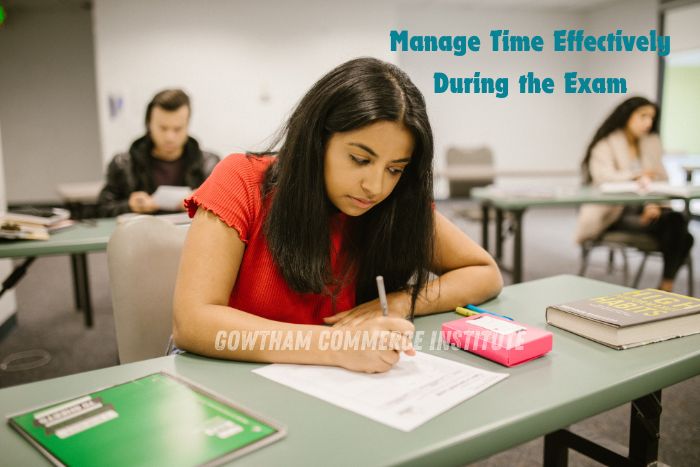
During the test, time management is absolutely important. Set out particular time for every section and try not to spend too much time on one question.
Exam Day Tips:
1. Read the question paper carefully before starting.
2. Attempt easy questions first to secure marks quickly.
3. Leave time for revising your answers.
3. Avoid Common Mistakes
a) Neglecting Certain Subjects
Every paper is equally significant. Steer clear of concentrating overly on one topic at the expense of others.
b) Skipping Mock Tests
One of the most important aspects of readiness are mock tests. Ignoring them will make you unprepared for the real test.
c) Overloading Yourself
Burnout can result from trying to study for protracted lengths without breaks. Plan your study times around frequent breaks and leisure activities.
4. Staying Motivated Throughout Your Preparation
a) Set Clear Goals
Specify your objectives for every study session and the exam taken as whole. Seeing your own success will inspire you.
b) Celebrate Small Wins
Whether your improvement comes from finishing a difficult topic or doing well on a practice test, recognize it.
c) Seek Support
Maintaining relationships with mentors or peers who can support and directionally guide you helps. At Gowtham Commerce Institute, we create a friendly learning environment meant to inspire our students.
5. The Role of Coaching Institutes
Your preparation might be much improved by a good coaching institute.
Why Choose Gowtham Commerce Institute?
1. Our experienced faculty uses real-world examples to streamline difficult subjects.
2. Notes and resources aligned with the syllabus are here.
3. Frequent tests and comments help to monitor development and raise performance.
4. Small batch sizes guarantee individual mentoring in personal development.
Conclusion: Your Path to CMA Success
With the correct techniques and direction, clearing the CMA Intermediate Exam on your first try is difficult but absolutely possible. To lay a strong basis, start early, keep consistent, and pay close attention to conceptual clarity.
Located in Peelamedu, Coimbatore, Gowtham Commerce Institute is dedicated to see you succeed. Our knowledgeable staff, extensive materials, and encouraging surroundings make sure you are ready for the CMA Intermediate Exam.
Are you prepared to move forward toward CMA certification? Come see Gowtham Commerce Institute now to be guided toward success!